





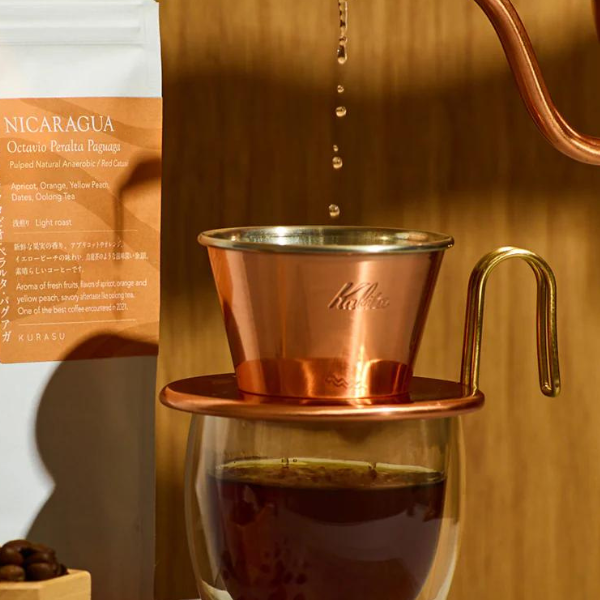

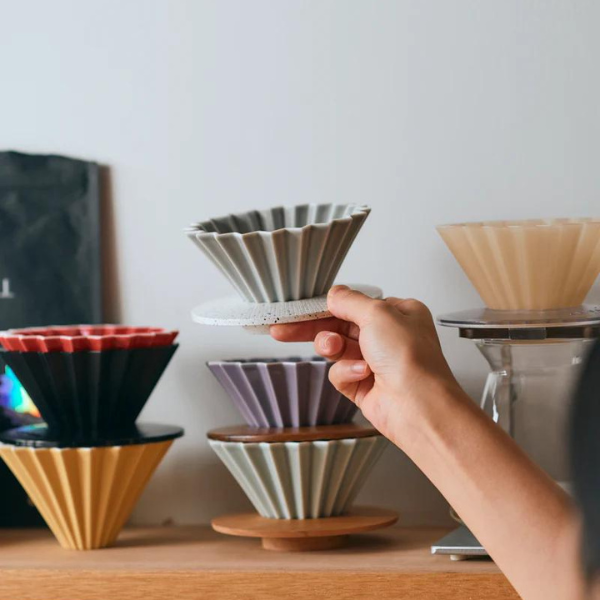





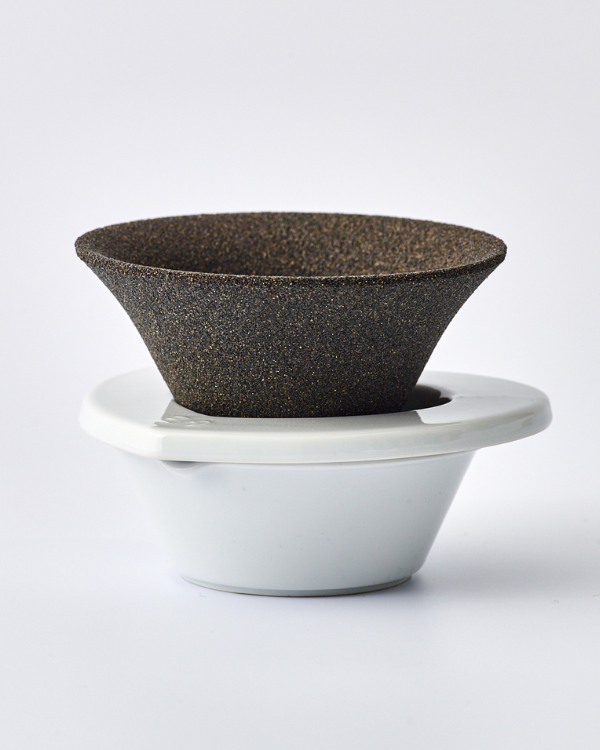
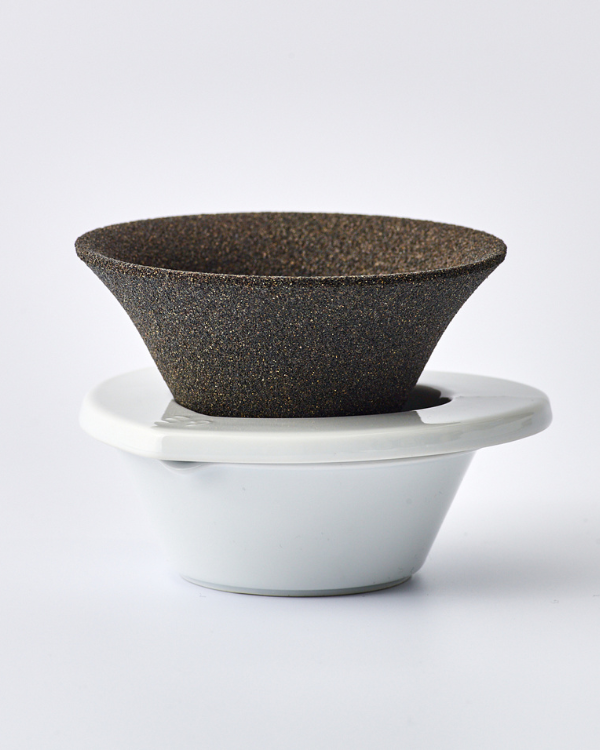


This is our recipe for enjoying Kurasu’s light-roast coffee at home.
Using a Hario V60 dripper, this recipe extracts approximately one cup of coffee from 12g of beans. It works with standard V60 drippers.
A little note: this recipe was tested using a size 01 ceramic Hario V60. Extraction time and temperature retention may vary slightly depending on the material and size of your V60.
Equipment Needed
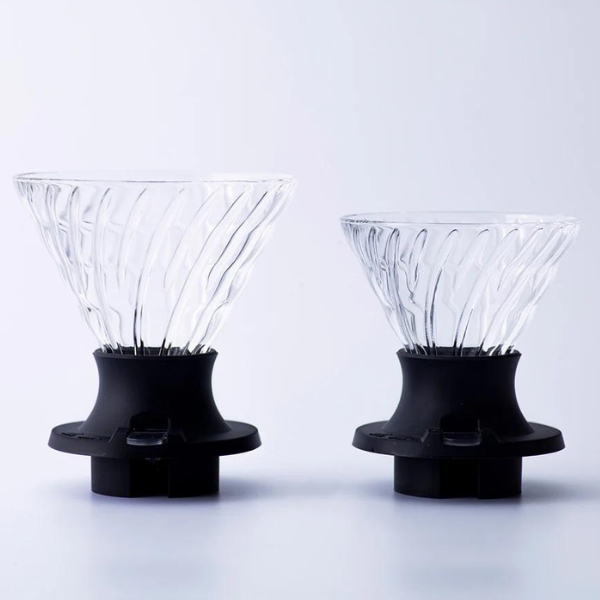
- HARIO V60 Dripper
- V60 paper filter
- Server or cup
- Drip kettle
- Scale
- Timer
- Coffee grinder
Basic Recipe
- Light-roast coffee beans: 12g
- Hot water: 200g
- Water temperature: Around 90°C
- Grind size: Coarse
- Coffee-to-water ratio: 1:16.7
- Estimated brewing time: 2 minutes 00 seconds to 2 minutes 30 seconds
Recommended Grind Settings by Grinder
- Comandante C40: 32 clicks
- Fellow Ode: #7.2
- Fellow Opus 2: #7.8
- Varia VS3 (Normal Burr): #13.5
- Wilfa SVART Aroma: Set to the “French Press” setting
The appropriate settings will vary depending on individual grinder characteristics, blade type, and zero-point calibration. Consider the numbers above as a starting point, and ultimately adjust based on the mouthfeel when you drink the coffee.
Pouring Schedule
- 0:00: Pour 40g → Total 40g
- 0:40: Pour 60g → Total 100g
- Around 1:10: Pour 50g → Total 150g
- Around 1:40: Pour 50g → Total 200g
Times are approximate. Starting with the third pour, do not rely solely on the time; check the condition of the coffee bed before beginning the next pour.
Brewing Procedure
It is important to follow the same routine every time.
To ensure a consistent coffee flavor, keep the environment and procedures—from boiling the water to rinsing the filter and finishing the brew—as consistent as possible. By repeating the process under the same conditions, it becomes easier to discern flavor differences caused by the beans or changes coming from adjustments you’ve made.
1. Boil the water
Prepare water at around 90°C.
In most regions of Japan, you can use tap water or water filtered through a standard water filter. If you’re concerned about a chlorine odor, use water that has been brought to a boil.
2. Measure and grind the beans
Measure out 12g of coffee beans and grind them to a coarse consistency.
After grinding, gently remove any silver skin or fine particles clinging to the sides of the dosing cup with your finger. Removing these can help produce a clearer flavor. You don’t need to remove every last bit.
3. Rinse the filter and warm the equipment
Place the paper filter in the V60 and rinse it with hot water. While gently holding the paper in place with your hand, pour hot water over the entire dripper.
Since ceramic and glass take time to warm up, preheat the dripper thoroughly until it feels slightly hot to the touch. Discard any water that has collected in the server.


5. First Pour: 40g
Starting at 0:00, pour 40g of hot water over approximately 10 seconds.
Pour the water in a spiral motion, keeping about 80% of the pour toward the center of the coffee bed and 20% toward the outer edge, to wet the entire bed of coffee grounds. Since the coffee bed in a cone-shaped dripper has some depth, moving the kettle slightly up and down near the center makes it easier to distribute the water evenly.
The first pour evenly wets the entire bed of grounds and releases the gases trapped in the coffee. This step lays the foundation for extraction, ensuring that water in subsequent pours can easily reach all parts of the grounds.

6. Second Pour: 60g
When the timer reaches 0:40, pour 60g of water over approximately 12 seconds, bringing the total to 100g.
Pour the water so that it covers the entire bed of grounds evenly. Aim for a 50-50 split between the center and the outer edges.
This second pour brings out the main elements of the coffee’s acidity and sweetness.

7. Third Pour: 50g
At around the 1:10 mark, once the water has drained from the dripper and is no longer visible on the surface, pour 50g of hot water over approximately 10 seconds to bring the total to 150g.
Prioritize the condition of the coffee bed over the time, and pour gently, directing slightly more water toward the center.
The third pour advances the extraction further, adding sweetness and body to the flavor. This step shapes the mouthfeel when you take a sip and the aftertaste that lingers after you swallow.
8. Fourth Pour: 50g
At around 1:40, once the water has drained again and the surface of the coffee bed begins to reappear, pour 50g of water over approximately 10 seconds, bringing the total to 200g. Again, pour gently, focusing slightly more on the center.
During the fourth pour, you’ll finish the extraction while fine-tuning the balance between the final strength and the aftertaste.
9. Remove the dripper
Once the coffee dripping from the dripper into the server slows to individual drops, remove the dripper. The recommended extraction time is 2 minutes 00 seconds to 2 minutes 30 seconds, but prioritize the flow of the liquid over the time.

10. Stir the coffee
Swirl the server about five times to evenly blend the brewed coffee.
Pour into a cup, and it’s ready to serve. Enjoy the evolving aroma and sweetness as the coffee cools.

Adjusting the Grind Size
The grind size affects the overall taste of the coffee, including acidity, sweetness, mouthfeel, and flavor. With conical-blade grinders—which are common for home use— the grind size affects the mouthfeel of the brew significantly.
Start by adjusting the grind size based on the mouthfeel when you drink it.
- Texture is too light or watery: Grind slightly finer
- Texture is too heavy or gritty: Make the grind slightly coarser
Once you find a grind setting that produces a pleasant mouthfeel, make a note of it—it will serve as your baseline for future brews.
Since conical blade grinders, in particular, tend to produce fine particles, a setting that appears quite coarse to the eye may actually be the most suitable.
About Water
Water hardness and mineral balance are among the key factors in bringing out the flavor of coffee. In particular, if the water is too soft, it can make it difficult to bring out sweetness; in some cases, this can have a greater impact than the grind size or amount of coffee.
The mineral balance and total hardness of tap water vary by region. This recipe uses water with a total hardness of approximately 60–90 ppm as a general guideline.
In many regions of Japan, coffee is brewed using tap water or water filtered through a standard water filter. If the chlorine odor in tap water doesn’t bother you, use it as is; if it does, bring the water to a boil before using it.
In areas where tap water is naturally soft, standard water filters or tap water itself may be more suitable than water filters that significantly remove minerals.
Proportions of Coffee Grounds and Hot Water
The recommended ratio is coffee grounds to hot water = 1:16.7.
For example, for 15g of coffee beans, use approximately 250g of hot water.
If you increase the amount of ground coffee, increase the amount of hot water accordingly to maintain this ratio. As a general guideline, the distribution of water for each pour should be 20%, 30%, 25%, and 25% of the total water volume.
- First pour: 50g
- Second pour: 75g
- Third pour: 62.5g
- Fourth pour: 62.5g
The timing of the pours and how to observe the coffee bed are the same as in the basic recipe.
To adjust the strength to your preference
If you find that the standard 12g/200g ratio produces a clean texture but tastes too weak, try increasing the coffee dose to 12.5g. We recommend keeping the water at 200g and adjusting the coffee dose in 0.5g increments.
Adjusting the amount of coffee is meant to change the strength of the brew. If you’re concerned about the texture of the liquid—such as it being watery or gritty—adjust the grind size rather than the amount of coffee.
When making adjustments, first fine-tune the texture with the grind size, then adjust the strength with the amount of coffee. After that, adjust the balance of acidity and sweetness by changing the number of pours and their timing.
How to Adjust the Flavor
Do not change multiple conditions at once; adjust them one at a time. Once you’ve determined a pleasant texture and your preferred strength, adjust the number of pours and their timing.
When the brew is too fast and lacks sweetness
Pour the combined 100g for the third and fourth pours in three separate pours of 40g, 30g, and 30g.
By keeping the total water volume at 200g and increasing the number of pours from 4 to 5, you can more easily extract the coffee’s components, allowing you to adjust the flavor toward a sweeter profile.
When the extraction is slow and the bright acidity is hard to detect
Try starting the third and fourth pours about 5 seconds earlier than in the basic recipe.
Shortening the duration of the latter half of the brew allows you to adjust the flavor to be lighter and brighter.
The structure of the beans and the speed at which water passes through them vary. Use the basic recipe as a starting point, and adjust it gradually to suit your home’s water, grinder, and personal preferences.


