The Dukunde Kawa Musasa Cooperative operates three washing stations, one of which is Mbilima. The Mbilima Washing Station began operations in 2007 and processes cherries delivered by 616 farmers in the surrounding area. The cherries are grown across 72 hectares of land and have received multiple international organic certifications.
Coffee trees are typically planted at intervals of 2 to 2.5 meters, with around 2,500 trees cultivated per hectare. Most producers are smallholder farmers, each managing an average of about 200 coffee trees.
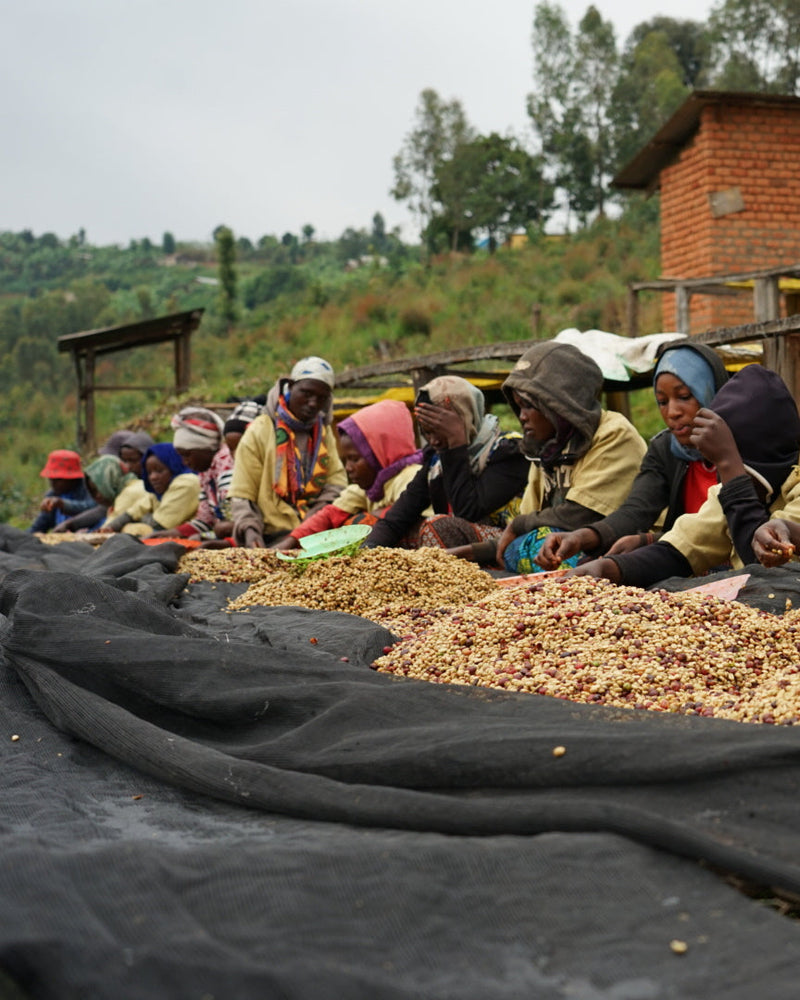
Upon delivery, cherries are first sorted on African drying tables, followed by flotation to remove lower-density cherries. After pulping, density sorting using water is carried out thoroughly to eliminate defects as much as possible.
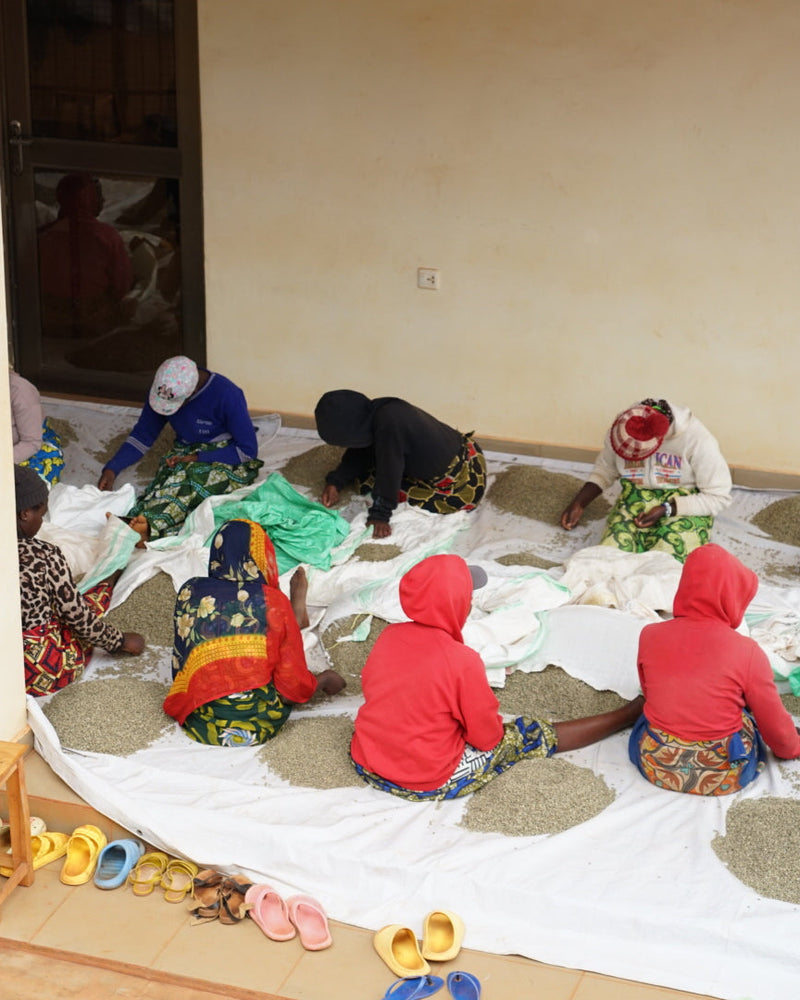
Hand-sorting continues throughout the drying stage, and the parchment coffee is sun-dried for approximately 24 days, depending on weather conditions.
Through these meticulous processes, coffee from Mbilima is produced in high-altitude hills above 2,000 meters, shaped by the care and dedication of the farmers. Harvests are carefully separated into small lots by picking date, ensuring consistency and traceability.
Coffee from Mbilima has earned recognition in the Cup of Excellence, with two lots placing in 2018. The cooperative as a whole has also received CoE awards in 2008, 2010, 2011, 2012, 2013, 2014, and 2018.
To maintain the highest quality of Bourbon variety coffee, each farmer strictly manages cherry ripeness. At the washing station, strict quality control is applied at every stage—from hand-sorting and washing to fermentation, grading, and drying—before the coffee is prepared for export to the international market.




![Rwanda Mbilima Soil Project Lot.0704[Light roast]](http://kurasu.kyoto/cdn/shop/files/image_Beans_Single_Rwanda-Mbilima-Soil-Project-Lot.0704-2026_2048x.jpg?v=1779845863)
![Rwanda Mbilima Soil Project Lot.0704[Light roast]](http://kurasu.kyoto/cdn/shop/files/Rwanda_Mbilima_Soil_Project_Lot.0704_c0e74251-24ac-4cf6-b6d2-2b0425d4afce_2048x.jpg?v=1779845833)
![Rwanda Mbilima Soil Project Lot.0704[Light roast]](http://kurasu.kyoto/cdn/shop/files/Rwanda_Mbilima_Soil_Project_Lot.0704-100_1_2048x.jpg?v=1779845876)
![Rwanda Mbilima Soil Project Lot.0704[Light roast]](http://kurasu.kyoto/cdn/shop/files/image_Beans_Single_Rwanda-Mbilima-Soil-Project-Lot.0704-2026_en_1_2048x.jpg?v=1779845889)
![Rwanda Mbilima Soil Project Lot.0704[Light roast]](http://kurasu.kyoto/cdn/shop/files/IMG_2041_2048x.jpg?v=1779845920)
![Rwanda Mbilima Soil Project Lot.0704[Light roast]](http://kurasu.kyoto/cdn/shop/files/IMG_9314_2048x.heic?v=1779845959)
![Rwanda Mbilima Soil Project Lot.0704[Light roast]](http://kurasu.kyoto/cdn/shop/files/DSC06406_2048x.jpg?v=1779846314)