











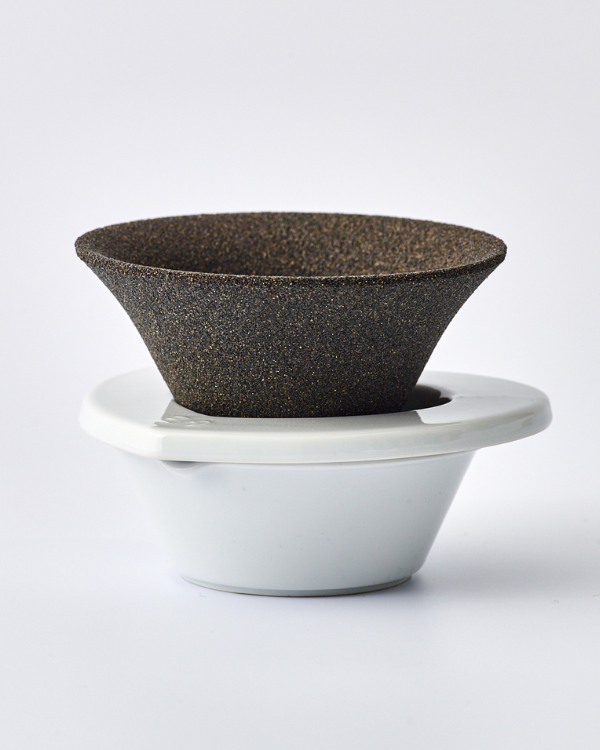
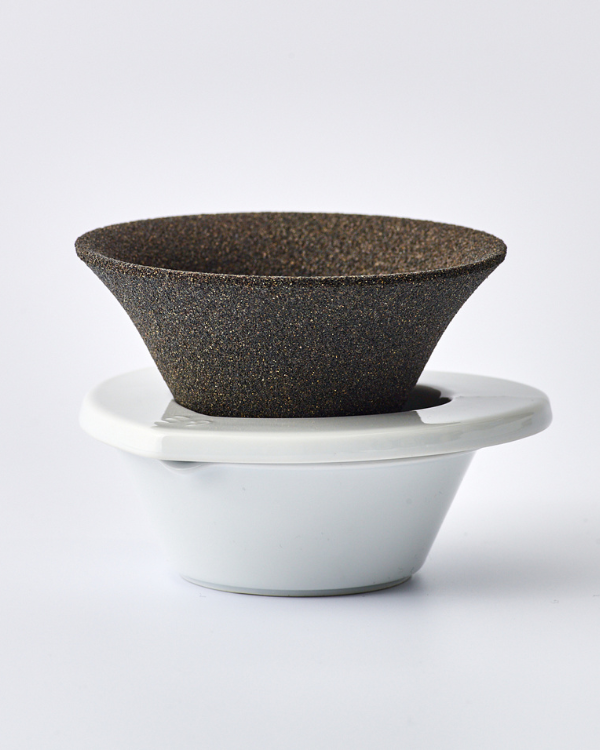


One day, quite suddenly, I felt the urge to turn my gaze toward the things we touch with our hands and the acts of it- pressing the shutter of a camera, or extracting coffee with an espresso machine, etc.
For those, we rely on what we call “recipes.”
A certain shutter speed for this light; 13 grams of coffee, ground this way, with 200 ml of water poured.
Standardized recipes and automation.
In our modern world, where uniformity is emphasized and fluctuations are minimized, I believe it is the work of baristas, roasters, and artists to notice the small changes and details that slip through the cracks.
Among the members of Kurasu, each with their own diverse background, one person who responds daily to the “things we touch”—their texture, form, and usability—is Runatsu, a barista and ceramic artist.
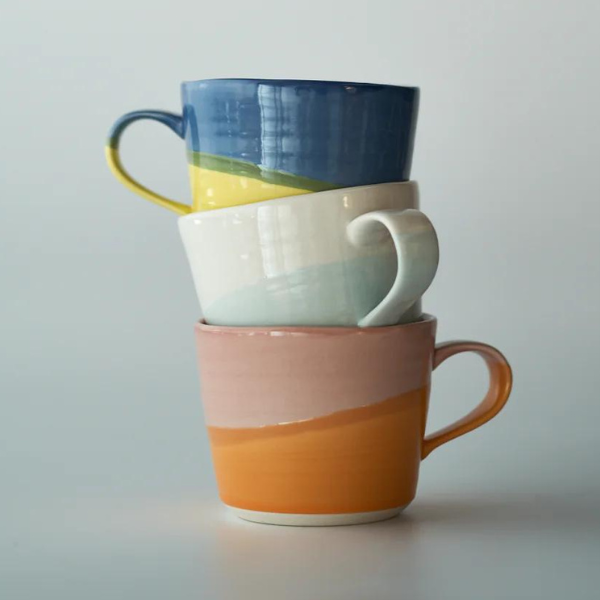
This time, we visited her studio and were given a glimpse behind the scenes of the making of the "Runatsu Ryokka Katakuchi", which Kurasu uses and sells as part of its artist collaboration at Kurasu Ebisugawa.
(Interview, Photography & Text: Jongmin / Special Thanks to Runatsu Kobayashi)
Related article: Meet Your Barista:Runatsu
Memories of Place, Recollections Evoked by Objects
It was 10 a.m. on one weekend.
We visited a one-room space with a large south-facing window.
A long, narrow room where living and working quietly overlap.
I first met Runatsu back in 2022, before I joined the editorial team, when I was working at the roastery. Whenever she brewed coffee as a barista, time around her seemed to slow down somehow.
Encountering her again as a ceramic artist feels like something that happened only recently. And yet, meeting her in that role felt as if we had reunited just slightly outside the circle of coffee.
It was like shifting the perspective—from looking at life through coffee, to re-examining coffee through life.
A soft breeze drifted in through the window.
She had recently traveled to Denmark with “ceramics and coffee” as her theme. As she shared stories from the trip, she brewed coffee for us, and the interview began.

Runatsu:
“When I was in Denmark this time, I spent a lot of time thinking about materials. There’s a famous brand there, Royal Copenhagen, known for its white porcelain. They were able to produce it thanks to a raw material called kaolin, mined on the island of Bornholm. That kaolin is incredibly white—somehow very delicate. Maybe that’s why Danish ceramics feel as though they carry a softness and sensitivity.”
“When I was a student, I created works around the themes of ‘scenery’ and ‘memory,’ and I feel like those ideas are still connected to what I do now. When you visit the places where materials are sourced, there’s an atmosphere you can only feel there—the humidity, the scent of plants carried by the wind, the fleeting moments when sunlight touches nature.”
“On Bornholm, there are many different raw materials, but the clear air and expansive nature of the island give off a certain energy. I felt, ‘This is where the kind of white I’m drawn to is born.’
White isn’t just a color—it’s a word we use for something much broader. It’s incredibly diverse and rich. The invisible time of the land, the density of what has accumulated—those things live within white.”

Seeing What Is Already There, Intensely and With Intent
Recently, I read an essay by Han Kang, the Nobel Prize–winning novelist, titled The White Book. It reflects on memories tied to “white things” such as snow, bones, ash, and rice.
I suddenly recalled Runatsu smiling as she once said,
“You know, pure white doesn’t really exist.”
Runatsu:
“I think white is a color that slightly lets light through, or reflects memory. Like when you look up at the sky and suddenly recall a feeling from a certain day. You see the same light, but your emotions change. Absolute white probably doesn’t exist—maybe it can’t be seen. Within white, there’s always shadow, and it changes expression depending on how the light hits it.
Every time I fire white vessels, I think, ‘Ah, this is the kind of white they became today.’”
“My pieces avoid unnecessary decoration as much as possible and are made through gradations of white. But within that white, there’s breathing. Each time light hits it, shadows emerge, and it appears as a different white. There are truly infinite kinds of white. That might be true for ceramics, and for paper as well. Right now, I’m still searching for the white that feels most calming to me.”
…
Today as well, she feels with both hands the white that emerges in the space between earth and light, memory and time. I asked her if there were any artists who had influenced her.

Runatsu:
“There’s an Italian painter named Giorgio Morandi. He painted still lifes of the objects in his studio from many perspectives. Just as I explore different expressions of white through how light passes through it, I love the way he doesn’t simply place objects there, but repeatedly looks at them, quietly confirming their presence.”

When she mentioned Morandi, I suggested she might also like Luigi Ghirri, the photographer who captured Morandi’s studio after his death. The conversation quickly became animated.
Ghirri distinguished between “ordinary reality” and “reality as it is,” photographing with a unique sense of framing and light. To truly see reality as it is, one must carefully observe its subtle, quiet fluctuations.
Reaching Out Toward the Brilliance of Nature
As we exchanged these gentle conversations, sharing what we each love, Runatsu began kneading clay. She moved into the process we often imagine—shaping vessels on a spinning wheel.
Watching her, kneading clay looked like physically demanding work. Fixing her hands in place on the rotating wheel and making fine adjustments also appeared to require significant strength.

Runatsu:
“In ceramics, there’s a process called ‘tightening the clay.’ It helps clean the inside of the vessel, but more importantly, it increases density and prevents cracking as it dries. Technique matters, but more than manipulating the material, there’s so much you feel just by touching the clay.”
“That’s why I want to someday make everything from raw materials myself—digging up clay, cutting trees in the mountains. I want to touch materials more directly.”
“My family home has a mountain. Our neighbors cut trees there and burn them in wood stoves. I’d like to use that ash to make glaze. The tree burns, becomes ash, and then returns into a vessel. That kind of cycle feels really meaningful to me.”
“It feels natural, but human hands are involved. It’s not untouched nature—but traces of the hand remain.”

Before we realized it, the mound of clay had found its own form, transforming into a vessel. It would be left to dry, then fired in a small kiln. Watching this, I imagined the katakuchi used to whisk matcha at Kurasu Ebisugawa being made in just this way.
This is more like an editor’s afterword, but after her work was finished, we shared lunch and exchanged many words—about care, about what living means.
If there was something we resonated on, it might be this: it’s important to recognize the state of everything we touch existing in an unfinished stage.
Unfinished or imperfect does not mean immature. Within it may lie something closer to its true nature. Clay before firing, before kneading, before processing—each stage holds quiet strength and possibility. How to bring that, with purity, into people’s daily lives through the form of “completion”—that, I felt, is the essence of her craft.
By witnessing this process, perhaps I, as a writer, was able to weave a story with words durable enough to last. A story to reread ten years from now. Objects you want to keep using. Flavors you want to keep drinking. Thinking about what those “well-tightened things” are, and gently incorporating them into everyday routines, might be a quietly joyful act.

Runatsu’s katakuchi can be seen and held only at Kurasu Ebisugawa—one of the many charms that can be experienced only at Kurasu’s physical stores.
A vessel that quietly accompanies your daily coffee or tea.
As light softly seeps into its white surface, memories will begin to live within it—growing richer the more it is used.


